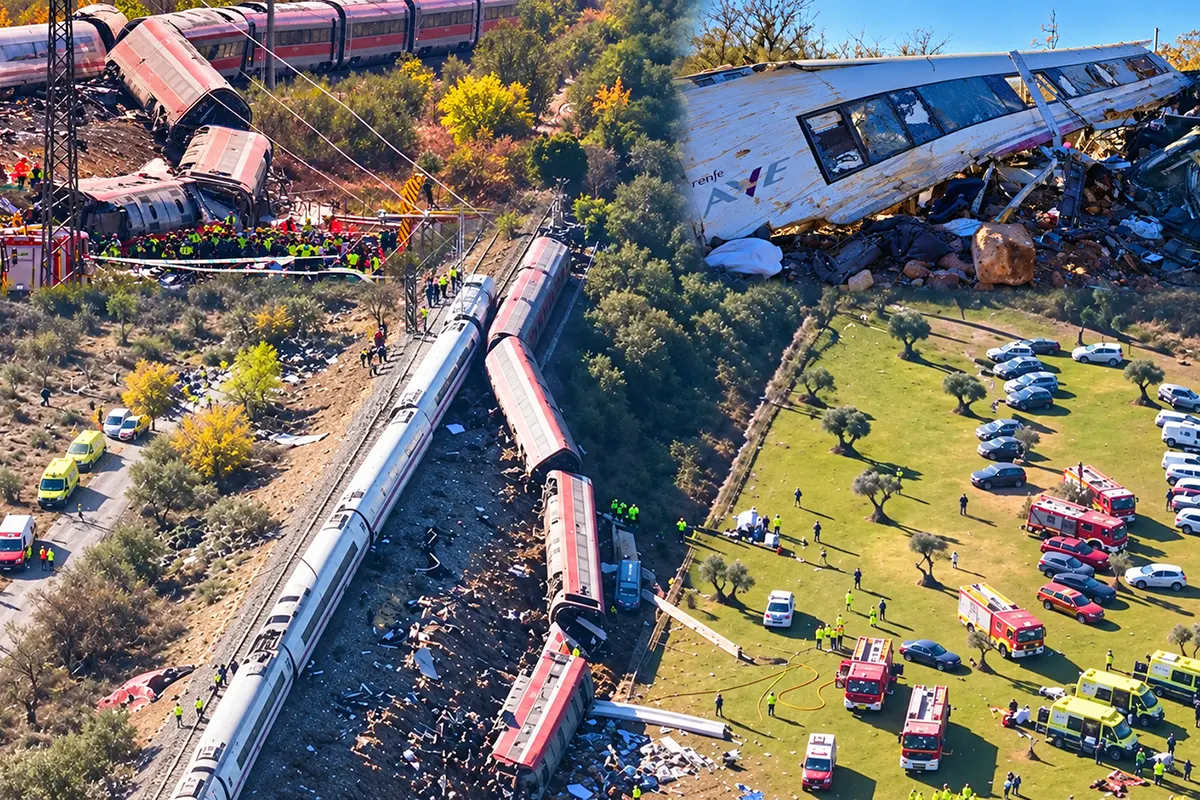
Turkey expressed its deepest condolences to Spain on Wednesday following the terrible train accident that occurred this morning in the Spanish province of Toledo, in which an AVE train collided from behind with a train operated by the private company Iryo that was stationary on the track near the town of Urda, resulting in at least 68 deaths and more than 100 injuries. More than 500 people were travelling on both trains, which were covering the Madrid–Seville route; this is the second rail disaster in the country in less than a year, following the fatal train crash in Adamuz (Córdoba), which left 46 people dead and 292 injured.
“We are deeply saddened by the tragic loss of life that occurred this morning in the train accident near the city of Toledo. We feel in our hearts the pain of our close friend and ally, Spain. We send our most sincere condolences to the families of those who died in the accident. Türkiye stands by Spain in both good times and bad,” read a message published this morning by the Turkish Embassy in Madrid shortly after news of the tragedy broke.
Similarly, in an official statement subsequently issued by the Turkish Ministry of Foreign Affairs, Ankara said: “We offer our condolences to the families of the victims and to the Spanish people, and we wish those injured a speedy recovery”. “We are deeply saddened by the loss of life resulting from the train accident that occurred today (28 October) near Toledo, Spain,” the statement said, adding that “there are no Turkish citizens amongst the victims” and confirming that the Turkish Embassy in Madrid is closely monitoring developments.
The Spanish government attributes the train accident to human error
Initial reports released by the Spanish authorities point to a possible human error, and sources within the government in Madrid suggested that an operator at the Atocha control centre may have given the AVE train driver the order to proceed despite another Iryo train blocking the track. However, as the morning has progressed, several experts have insisted that a ‘rear-end’ collision between two trains is impossible due to all the redundant safety systems in place.
The Spanish Minister for Transport himself, Óscar Puente, has stated that “it is a truly implausible accident”, explaining that a computer fault caused the LZB control system at Hurta station (which monitors train speeds) to crash, bringing around six trains to a halt in the area; Puente pointed out that, with the system down, control was taken over by the control centre at Atocha (Madrid), which contacted the stopped trains and, inexplicably, ordered the AVE train at around 8.36 am to resume its journey “as normal” despite the presence of the Iryo train some 25 kilometres further along the track and the fact that there was a “red signal”.
The AVE train collided with the Iryo at 200 km/h
The AVE reached a speed of around 200 km/h, despite the fact that protocols stipulate it should have resumed its journey at no more than 40 km/h for safety reasons, and after some 15 minutes had passed without any reaction from the Atocha control centre, it collided with the Iryo train. Commenting on this irregularity, the minister emphasised that “the decision to resume services lies with the control centre”.
“We are absolutely devastated; this is one of the hardest moments one can face,” said Puente, who confirmed that the person who gave the order has been identified. When asked whether he was considering resigning, the Spanish government’s Transport Minister replied that at the moment his sole focus was on clarifying what had happened and “managing the situation”, and he insisted that Spain’s rail system is “reliable and safe” and “comparable to that of other countries in our region”.
Puente commented that the control centre even went so far as to order yet another train to resume “normal operation”, but that it was the driver himself who warned Atocha “this cannot be normal; it has to be ‘on sight’ (at a moderate speed of 40 km/h)”, to which the operator in Madrid replied by confirming that he had made a mistake and that it should be “on sight”.
Advanced active monitoring and management systems such as ERTMS Level 2 – still in the process of being rolled out – or LZB itself – had it remained operational – would have prevented the disaster by electronically enforcing a safe braking distance between the trains. However, the safety systems failed to activate because they were overridden by human error: faced with a widespread IT blackout, operators at the control centre in Madrid resorted to a manual emergency protocol and issued a verbal order authorising the AVE train to proceed blindly along an occupied section of track, thereby overriding the automatic safety systems.
Two fatal high-speed train accidents in Spain in less than a year
This is the second train accident in less than a year on the high-speed line between Madrid and Andalusia, which was the first to be opened in Spain following the 1992 Seville World Expo and which, particularly in recent years, has been plagued by maintenance issues, a lack of punctuality and recurring technical faults, resulting in a gradual decline in passenger numbers.
Following the tragic accident at Adamuz in January 2026, trade unions representing train drivers and staff at Adif – the public body that manages and maintains the Spanish rail network – denounced a neglect of maintenance of the infrastructure, a lack of investment and an alarming deterioration in safety on what is Spain’s oldest high-speed line.
Specifically, testimonies from train drivers have been highlighting the high frequency of faults, with more than a hundred track breaks a year; problems that are often merely ‘patched up’ with permanent temporary speed restrictions rather than being addressed with effective solutions. It was precisely the train accident in Adamuz — caused by a pre-existing fracture in a weld on a renovated section of track — that brought to light allegations regarding the use of low-cost materials, deficiencies in automatic signalling systems and negligent management of the railway system in Spain.
VOTE

EDITORIAL TEAM
🧿 About us
.
Edited and reviewed by:

Pablo Gómez is a specialist in Turkey and has been editor-in-chief of Hispanatolia since 2011. He has been analysing current affairs and geopolitics in Turkey and the surrounding region since 2006.
…
📣 Your ADVERTISING on Hispanatolia
.
🤗 HELP US WITH A DONATION:
💗 Paypal