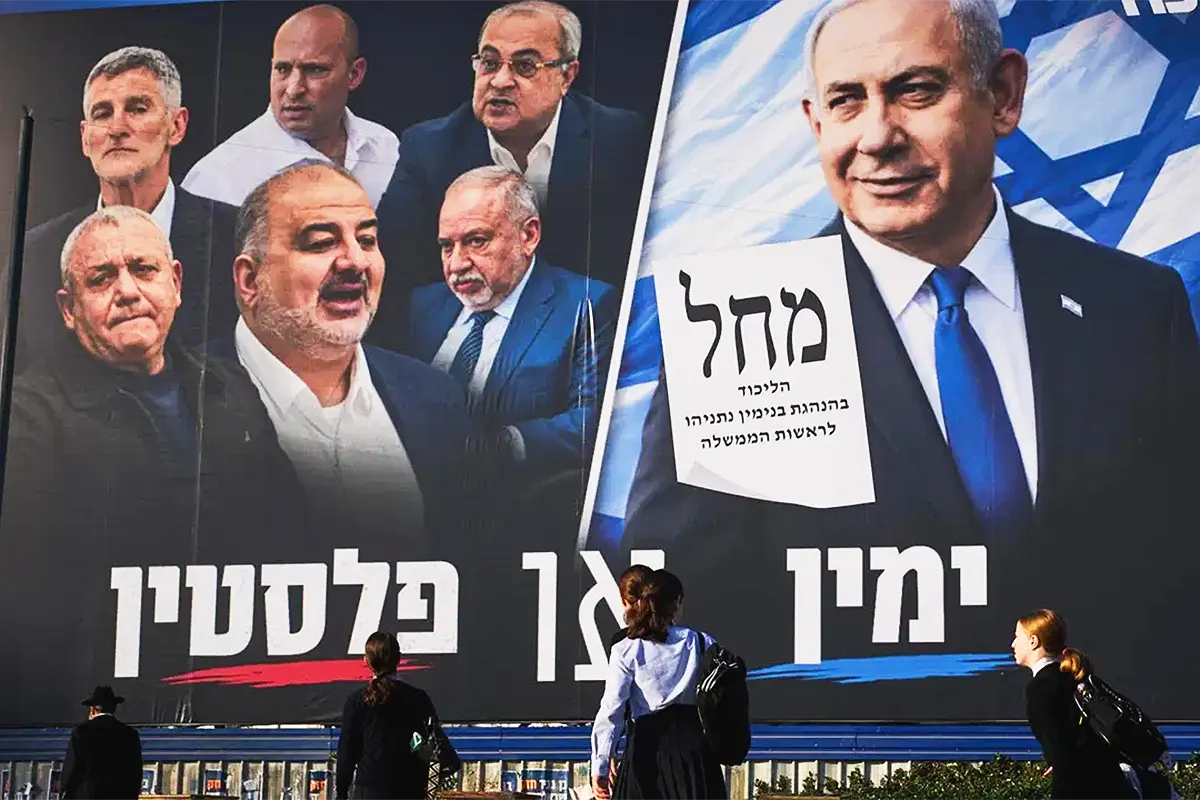
The Government of Turkey denied on 29 October the allegations regarding the alleged funding of Arab parties in the Israeli parliamentary elections. The Centre for Combating Disinformation (DMM), a body under the Presidency’s Communications Office, described as “completely unfounded” the claims regarding alleged Turkish interference in that country’s elections, as published in the Israeli press.
In a statement released by the Turkish news agency Anatolia, the DMM stated that “The claims circulating in some international media outlets and on social media platforms alleging that ‘Turkey interfered in the Israeli elections’ are completely without foundation. These claims form part of a deliberate and brazen disinformation campaign aimed at manipulating public opinion. We strongly urge the public not to give credence to these false reports and claims whose purpose is to deceive”.
Shin Bet investigates possible foreign funding of Arab communities in Israel
The newspaper The Jerusalem Post has in recent hours published a news article on an investigation launched by Israel’s internal security service, known as Shin Bet, following suspicions that “foreign entities, potentially including Qatar and Turkey, funneled money into Israel to influence voting in Arab communities” during the recent Israeli elections.
According to the Israeli newspaper, the chairman of Israel‘s Central Elections Committee, Noam Sohlberg, is reported to have ordered the security agency to investigate the suspicions of foreign funding and electoral bribery.
Sources at the Central Elections Committee told The Jerusalem Post, however, that this investigation will not delay the publication of the final election results, nor will it prevent the President of Israel, Isaac Herzog, from appointing a party leader to begin the process of negotiations aimed at forming a government.
Ben Gvir calls for the arrest of Israeli Arab leaders
On 29 October, Israeli Prime Minister Benjamin Netanyahu’s bloc stepped up pressure on the leaders of Israel’s Arab parties over allegations of foreign funding, in an attempt to weaken their position following an election with no clear winner, in which the parties of the Arab minority – which accounts for around 20% of the Israeli population – could prove decisive after a record turnout of 80% was recorded amongst the Arab community, which has traditionally been characterised by abstention in Israeli elections.
The fact is that neither Netanyahu nor the opposition bloc led by Gadi Eisenkot, former Chief of Staff of the Israel Defence Forces, appears to have secured sufficient support to reach the 61 seats needed to secure a majority in the Knesset, the Israeli parliament. This leaves the two main Arab parties – the so-called left-wing Joint List (11 seats) and the moderate Islamists of Ra’am (8 seats) – as key players in securing a governing majority.
Following the elections in Israel, the Minister for National Security, Itamar Ben Gvir, a far-right, supremacist politician, has even gone so far as to call on the Shin Bet in recent hours to order the immediate arrest of the leaders of the Arab parties, fearing that their votes could wrest power from the far-right coalition led by Netanyahu’s Likud. Indeed, opposition supporters have taken to the streets of Tel Aviv to call for the formation of a coalition government between Eisenkot’s bloc and the Arab parties that would remove Netanyahu from power.
VOTE

EDITORIAL TEAM
🧿 About us
.
Edited and reviewed by:

Pablo Gómez is a specialist in Turkey and has been editor-in-chief of Hispanatolia since 2011. He has been analysing current affairs and geopolitics in Turkey and the surrounding region since 2006.
…
📣 Your ADVERTISING on Hispanatolia
.
🤗 HELP US WITH A DONATION:
💗 Paypal