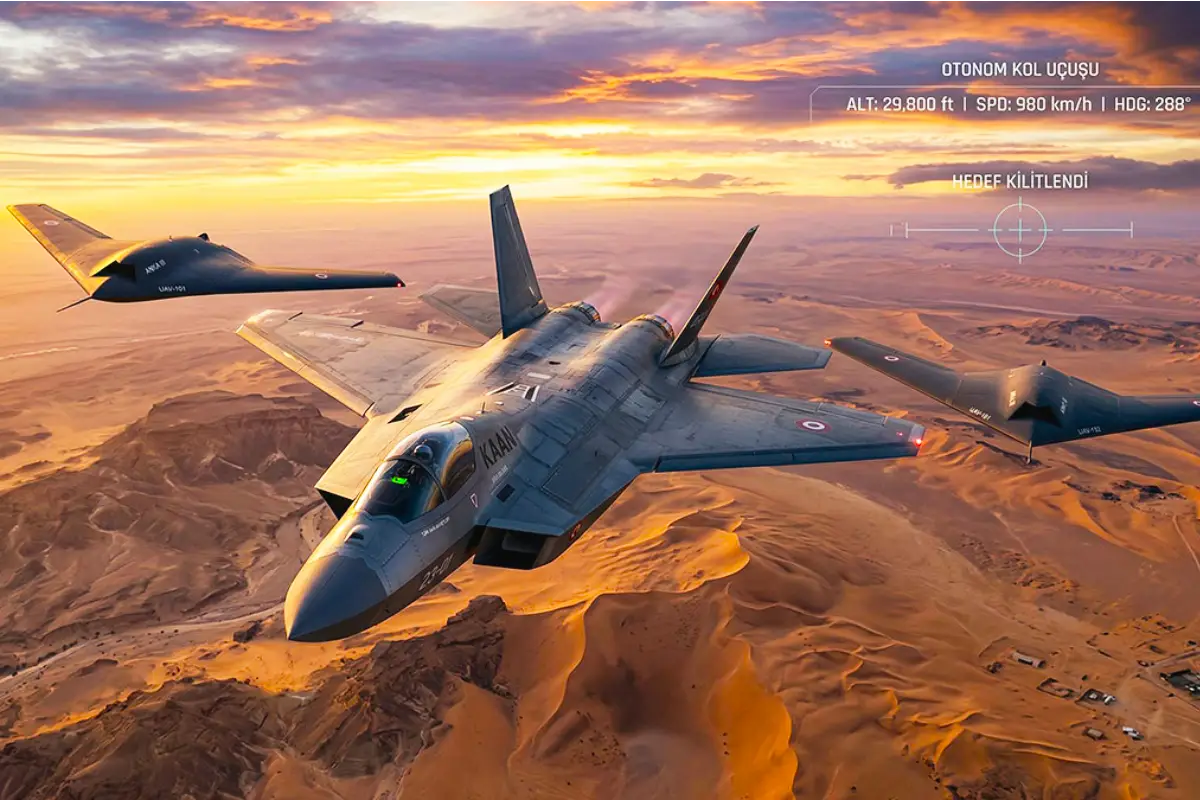
The KAAN, the Turkish fifth-generation fighter, is attracting the attention of the international press due to the progress made during its development and testing, particularly in the Middle East.
Newspapers such as The New Arab note that the new fighter aircraft could provide the Eurasian country with a “significant advantage in stealth air power”, and state that Saudi Arabia is in advanced negotiations with Ankara to participate in the project.
KAAN aims to become an alternative to the F-35
Developed with features typical of fifth-generation fighter jets, such as stealth technology, the ability to carry weapons in internal bays, advanced radar, electronic warfare and sensor fusion, the KAAN fighter jet is considered a potential alternative to the US F-35 for countries seeking to modernise their air forces. The Turkish newspaper Akşam emphasises that the fact the aircraft has been designed from scratch using Turkey’s own resources represents one of the most significant steps towards Turkey’s goal of establishing an independent fighter aircraft industry.
According to another report published by the Qatar-based newspaper The New Arab, the Turkish KAAN fighter programme is not merely a military project, but also a significant part of Türkiye’s long-term objectives regarding the defence industry. The report highlights that, if the aircraft can incorporate domestically manufactured engines, radars and electronic warfare systems, Ankara will have crossed a significant threshold in its strategic independence in the defence sector, adding that the KAAN could transform Turkey’s position within the structure of air power in the region.
The greatest challenge facing the KAAN programme
The development of the engine is, however, one of the most critical aspects of the KAAN programme. The prototypes and early production versions of the aircraft have been using F110 engines manufactured by the US firm General Electric, whilst Turkey continues to develop its own domestically produced TF35000 engine, with a thrust of 35,000 pounds. According to the plans of Turkish Aerospace Industries (TAI/TUSAŞ), the integration of the domestically manufactured engine into the KAAN aircraft is scheduled for approximately 2032; however, until the home-grown engine is ready, the aircraft will continue to fly with F110 engines.
The article published by The New Arab highlights in this regard that the manufacture of engines for advanced fighter jets is an extremely complex process due to the need to use high-temperature-resistant alloys, turbine cooling technologies, precision manufacturing systems and advanced control systems.
Saudi Arabia seeks to participate in the KAAN project
The New Arab also reports that Türkiye is in contact with several countries interested in the KAAN programme, notably Saudi Arabia, which is exploring ways to participate in the project and is reportedly already holding advanced talks with Turkey regarding a potential partnership agreement.
The Qatari newspaper maintains that the KAAN has the potential to place Turkey amongst the small number of countries capable of developing advanced fighter aircraft, whilst noting that the project will take time to reach full maturity. According to The New Arab, a fully developed KAAN, equipped with engines, radars, electronic warfare systems and domestically manufactured ammunition, could provide Türkiye with a high-calibre, independent air force.
The publication concludes that Turkey’s strategic independence would be significantly strengthened by having its own fifth-generation fighter, providing Ankara with a “significant advantage in stealth air power” over Israel and shifting the military balance in the Middle East in Turkey’s favour.
VOTE

EDITORIAL TEAM
🧿 About us
.
Edited and reviewed by:

Pablo Gómez is a specialist in Turkey and has been editor-in-chief of Hispanatolia since 2011. He has been analysing current affairs and geopolitics in Turkey and the surrounding region since 2006.
…
📣 Your ADVERTISING on Hispanatolia
.
🤗 HELP US WITH A DONATION:
💗 Paypal