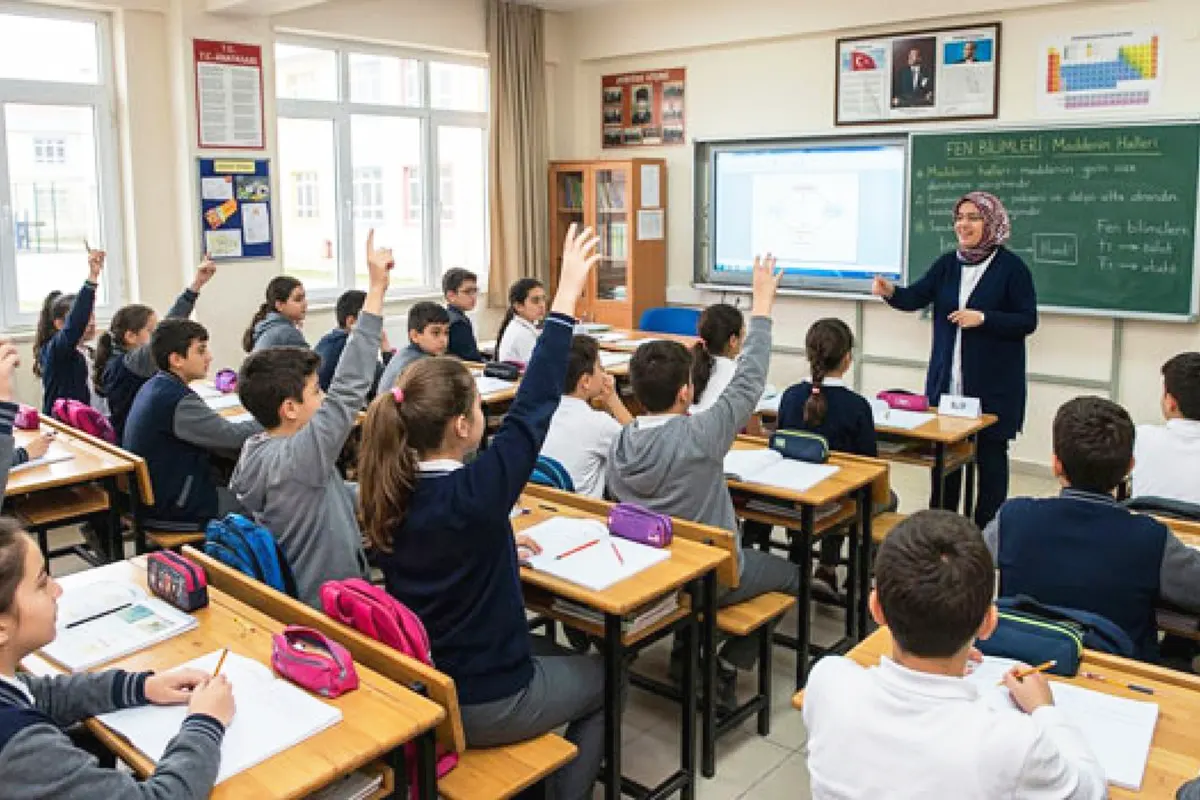
Turkey has achieved very good results in science, reading and mathematics in the latest PISA 2025 report, and is also the country that recorded the greatest improvements amongst OECD member states in all three areas.
The Eurasian country achieved the greatest progress amongst OECD members in the three subjects assessed by the Programme for International Student Assessment (PISA) for 2025 – which assesses a total of 91 countries and economies – raising its scores despite a decline in average performance both amongst OECD countries and across all participating states, according to the Turkish news agency Anatolia.
Particularly notable progress among Turkish students in science
The report’s results showed particularly notable progress in science, the main subject in the 2025 cycle. Turkey scored 494 points, an improvement on 2022 and 2018.
The OECD average was 482 points, whilst that of the participating countries as a whole stood at just 443. As a result, the country also narrowed and reversed the previous gap with the OECD average, coming above that average in science.
Reading results also exceed the OECD average
In reading, Turkey’s average score increased compared with 2022 to reach 472 points, whilst the OECD average fell to 461 and that of all participating countries stood at just 420. Consequently, the country outperformed both benchmarks.
Turkey’s performance in reading also showed a considerable improvement when long-term scores from previous years are taken into account. In 2018, Turkey’s score was 21 points below the OECD average, whilst in the latest report it now stands 11 points above it. The gap between the Eurasian country’s score and the average for all participating countries has also widened between the two years, rising from 13 points in 2018 to 52 points in 2025.
As for the mathematics assessment, Turkey has raised its average score compared with 2022, reaching 462 points in 2025. The OECD average in this case was 463 points, according to the latest PISA report, whilst that of the participating countries as a whole stood at 429. It can therefore be said that Türkiye has managed to remain above the overall international average in mathematics and has reached the OECD average.
The number of high-achieving Turkish students doubles
The report’s findings also showed significant improvements in the proportion of high-achieving students. In science, the percentage of Turkish students at the highest levels rose from 4% in 2022 to 7.4% in 2025 and exceeded the OECD average for the first time, which stands at 7.2%. In reading, the proportion also rose from 1.9% to 4.2%, as it did in mathematics, where it rose from 5.4% to 7.9%.
Turkey also increased the proportion of pupils who achieved at least the basic level of performance in all three subjects. Overall, the proportions of Turkish pupils who achieved both the minimum and high levels of performance reached their all-time highs in the PISA assessments.
Turkey improves its ranking in all three subjects
Globally, it can be said that the country improved its ranking in all three subjects. Among the 91 participating countries and economies, Turkey made progress in science, reading and mathematics compared with the 2022 results, when only 81 countries and economies took part. In science, Turkey has climbed from 34th to 19th place; in reading, it has risen from 36th place in 2022 to 18th in 2025; and in mathematics, it has risen from 39th to 28th place.
Among OECD members, the Eurasian nation also improved its ranking in all three assessed areas, with progress in science (from 29th to 14th place), reading (rising from 30th to 13th place) and mathematics (moving from 32nd to 23rd place) compared with the 2022 rankings.
Turkish steady improvement contrasts with the decline seen amongst OECD countries
The results of PISA 2025, published simultaneously worldwide, assess 15-year-old students enrolled in formal education in science, reading and mathematics every three years.
In the PISA assessments carried out between 2003 and 2025, Turkey’s relative ranking has continued to improve across all three subjects, rising by 60% in science and reading and by 52% in mathematics in just over 20 years.
In 2003, Turkey ranked among the lowest of the OECD member states in science, reading and mathematics, whereas it has now managed to exceed the OECD average in two of the three subjects assessed and match it in the third: a development that is particularly significant against a general backdrop of declining student performance across the OECD.
Turkey has thus become the only OECD member country to have increased its scores in all three subjects assessed by the PISA report over the last decade. It is also the organisation’s member country that has recorded the largest increases in all three areas compared with the previous assessment, carried out in 2022.
VOTE

EDITORIAL TEAM
🧿 About us
.
Edited and reviewed by:

Pablo Gómez is a specialist in Turkey and has been editor-in-chief of Hispanatolia since 2011. He has been analysing current affairs and geopolitics in Turkey and the surrounding region since 2006.
…
📣 Your ADVERTISING on Hispanatolia
.
🤗 HELP US WITH A DONATION:
💗 Paypal